
Guarded Swaps Are Live on Velora: Best Price Without the Fail Rate
Jul 23, 2026

Product


RFQ and PropAMM quotes are often the best price onchain. They are also the first thing to die between click and confirmation.
That gap is where good trades go to waste. You see a tight quote, you submit the transaction, and by the time it lands the firm quote has expired, the market maker has pulled, or the PropAMM path no longer fills. The swap reverts. Gas is spent. You start over.
Guarded Swaps are built for that moment. They keep the tight quote when it fills, and attach an on-chain AMM backup when it does not. Same transaction. No extra click. No manual retry.
The problem with “best quote” execution
Modern aggregators do not only route through public AMMs. They also source firm quotes from RFQs and PropAMMs because those venues often price better, especially on size and on less liquid pairs.
The tradeoff is reliability.
A firm quote is a promise with a short shelf life. Between the moment you see it and the moment your transaction is included:
the quote can expire
the maker can fail to settle
liquidity conditions can change enough that the primary path reverts
Standard routing has a blunt answer: if the primary path fails, the whole transaction fails. You paid for a failed attempt and still need to re-quote.
That is a bad user experience for traders. For wallets, dApps, and partners embedding swaps, it is worse. Failed fills look like product bugs even when the underlying issue is quote timing.
What Guarded Swaps do
Guarded Swaps keep RFQ and PropAMM pricing as the primary path, then encode an on-chain AMM fallback inside the same swap transaction.
In plain terms:
Velora still tries the best firm quote first.
If that primary path reverts at execution, the on-chain fallback runs automatically.
The fallback starts from the same input amount, inside the same transaction.
If the firm quote fills normally, the fallback never needs to run.
You get the upside of tight offchain or proprietary liquidity without turning every expired quote into a dead swap.
How it works
At pricing time, when a route uses a firm-quote venue, Velora can attach a priced AMM alternative for that hop. That sits on top of Velora’s routing stack, including MAP (Multi-Asset Pathing), so multi-hop routes can still carry a guarded firm-quote leg.
At execution time, Augustus runs the primary path first. If it reverts, control moves to the fallback path. Intermediate setup on the failed attempt is rolled back with it, so the fallback starts clean from the original input for that group.
Important properties:
Automatic. No second signature and no user intervention.
Atomic. Primary attempt and fallback live in one transaction.
Bounded. Fallbacks are only kept when they can settle within the user’s slippage constraints.
Selective. The mechanism targets firm-quote hops where expiry and pull risk are real, not every hop for decoration.
For traders, that means fewer failed swaps when the best quote dies late. For integrators, it means better fill reliability without changing the basic quote-and-swap flow.
A real mainnet example
Shortly after launch, a mainnet swap showed the mechanism in production.
Pair: weETH → USDC
Size: about 4.93 weETH (~$10k)
Path: Curve filled the first hop into WETH
Primary on hop 2: firm quote reverted at execution
Fallback: Uniswap V3 AMM filled in the same transaction
Outcome: user received USDC; the swap completed
Without Guarded Swaps, that transaction would have reverted after the firm quote failed.
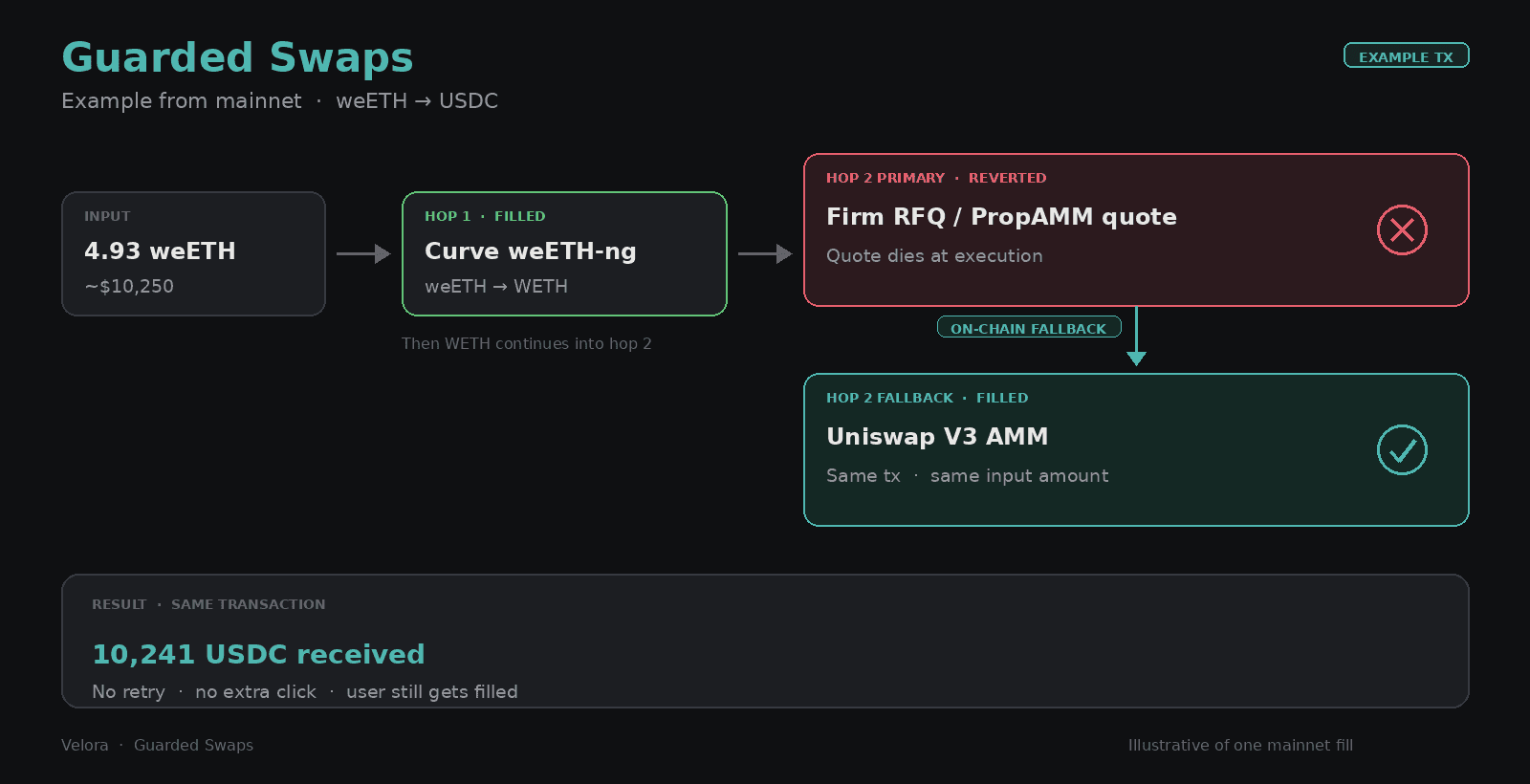
View the transaction on Etherscan
This is the point. Guarded Swaps are not a marketing label for “smarter routing.” They are a concrete execution path: try the best firm quote, survive when it dies.
Why this matters
Better quotes without worse reliability
Aggregators should not force a choice between:
pure AMM routes that are more durable but sometimes worse priced, and
RFQ / PropAMM routes that are tighter but more fragile at settlement
Guarded Swaps reduce that tradeoff. Take the firm quote when it works. Land through AMM liquidity when it does not.
Fewer wasted transactions
A revert is not free. Users lose time, gas, and confidence. Partners absorb support noise. Guarded Swaps turn a class of late-stage quote failures into completed fills.
Alongside MEV protections on Velora, Guarded Swaps target a different failure mode: the quote that dies after you click.
Cleaner partner UX
Wallets and dApps should not need custom retry logic for every firm-quote failure. With Guarded Swaps live on Velora routes, the recovery path is already inside the transaction.
That matters for embedded flows too. Partners already ship Velora liquidity inside their own products, from Market API routes to in-app widgets (for example Morpho’s in-app swaps). Higher fill reliability makes those surfaces feel like product quality, not quote roulette.
Live for users and partners
Guarded Swaps are live now:
on the Velora app
for partners integrating Velora
No special mode to toggle for end users. When a route carries a firm-quote primary with a valid fallback, the guardrail is already encoded.
Builders can start from the Velora docs, including the Delta overview for intent-based flows.
Where Guarded Swaps fit in the Velora stack
Velora is an execution layer, not a single product button. Guarded Swaps sit alongside the rest of that stack:
Market API routing across DEXs, RFQs, and PropAMMs, powered by engines like MAP
Intent-based execution through Delta (how intent-based trading works)
Crosschain swaps
Limit orders and TWAP
Widget and API surfaces for partners
The shared theme is simple: better outcomes under real market conditions, not only better quotes on a screen.
Who benefits most
Guarded Swaps are especially useful when:
routes include RFQ or PropAMM liquidity
quote lifetime is short relative to wallet confirmation time
size is large enough that re-quoting after a revert is painful
partners care about fill rate as much as headline price
If your flow already leans on firm quotes for price, Guarded Swaps make that strategy safer to ship.
For larger size, where the goal is lower market impact rather than surviving a single-quote failure, pair this with TWAP-style execution and TWAP on Velora.
FAQ
What are Guarded Swaps?
Guarded Swaps are Velora’s on-chain fallback mechanism for firm-quote routes. The swap tries the RFQ or PropAMM quote first. If that primary path reverts, an AMM backup can fill in the same transaction.
Do Guarded Swaps change the quote I see?
No. You still get the best available route at quote time. The difference is what happens if the firm-quote primary fails at execution.
Will the fallback always run?
No. If the primary firm quote fills successfully, the fallback does not need to run.
What happens if the primary quote expires?
If the primary path reverts because the quote expired or failed to settle, the on-chain AMM fallback can take over inside the same transaction, subject to slippage constraints.
Do I need to do anything extra in the app?
No. Guarded Swaps are automatic when the route supports them.
Is this available to partners?
Yes. Guarded Swaps are live for partners building on Velora, not only for swaps in the Velora app.
Where can I learn more as a builder?
Start with the Velora docs and the Delta overview.
Try it
Best price when the quote fills. Reliable execution when it does not.
Guarded Swaps are live on Velora today.
Discover more about Velora

