
How Large Trades Impact Your Execution (And How to Avoid It)
May 6, 2026
Product


When you place a large trade on a decentralized exchange, the price you see is rarely the price you get. The difference tends to increase as trade size grows.
This becomes particularly relevant as trade sizes move beyond typical retail volumes, especially in fast-moving or fragmented liquidity environments.
It’s not a bug. It’s how onchain markets work.
Why Large Trades Move the Market
Most decentralized exchanges rely on liquidity pools spread across multiple venues.
When a large order is submitted, it consumes the best available liquidity first, then continues filling at progressively worse prices.
Large trades don’t just follow the market. They influence it.
This effect is typically referred to as slippage, but slippage is only part of what’s happening.
The Hidden Cost of Execution
There are several factors that quietly impact the outcome of a trade.
Slippage reflects how prices move as liquidity is consumed. MEV (Maximal Extractable Value) introduces additional risk as transactions can be observed and acted on by third parties. Fragmented liquidity can also lead to suboptimal routing across venues.
Individually, these may seem limited at first. They don’t stay that way.
These effects repeat every time a large trade is executed this way. Over time, the difference becomes hard to ignore.
Execution Strategy Matters More Than It Seems
In traditional finance, execution is treated as a discipline in its own right.
In crypto, it’s often overlooked.
Yet two identical trades can produce very different outcomes depending entirely on how they are executed.
At smaller sizes, this difference can go unnoticed. As trade size increases, it becomes much more visible.
In practice, this is one of the most overlooked sources of inefficiency in onchain trading.
What Is TWAP (Time-Weighted Average Price)?
TWAP is an execution strategy designed to reduce the market impact of large trades.
Instead of executing a full order at once, a TWAP order splits it into smaller parts and executes them gradually over a defined period of time.
It spreads execution out, rather than concentrating it in a single moment.
TWAP is a standard approach in traditional markets and is becoming increasingly relevant in onchain trading as liquidity and trade sizes grow.
TWAP is one of the most effective ways to reduce slippage when executing large trades on decentralized exchanges.
How TWAP Improves Execution
By distributing execution over time, TWAP reduces immediate pressure on liquidity and improves the average execution price. It also lowers the visibility of large orders.
For trades where size matters, this tends to produce more consistent outcomes.
TWAP on Velora
TWAP is available on Velora as part of a broader execution framework designed to improve how trades are handled onchain.
Rather than relying on a single transaction, TWAP allows trades to be distributed over time, while benefiting from additional safeguards built into the protocol.
This includes the ability to execute both buy and sell orders over time, apply price protection during execution, and reduce exposure to MEV-related risks.
Execution is further optimized through Velora’s hybrid architecture, combining aggregation and intent-based routing to improve how orders are filled.
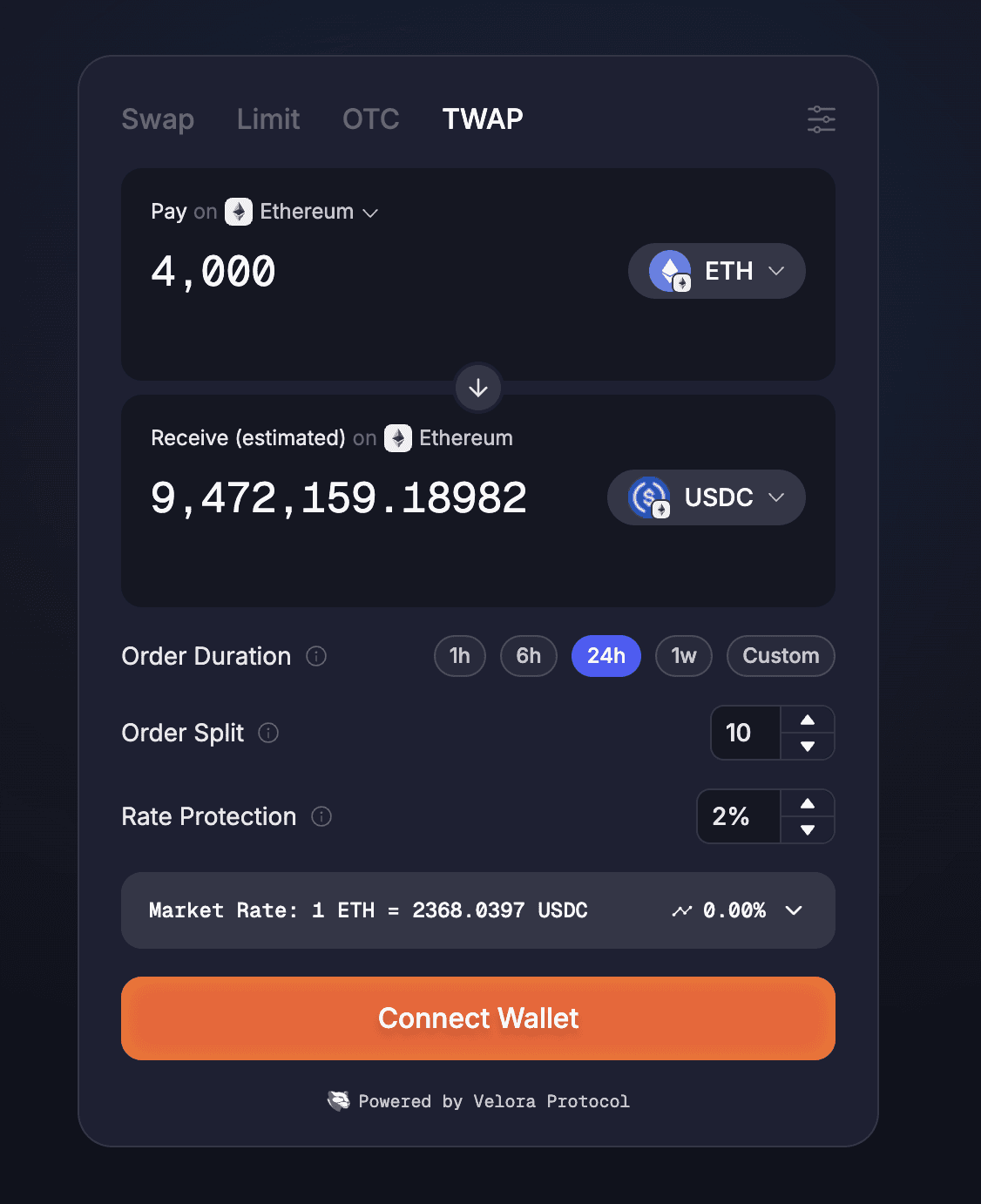
You can access TWAP directly in the Velora app.
A Simple Example
Consider a $5M trade from USDC into ETH.
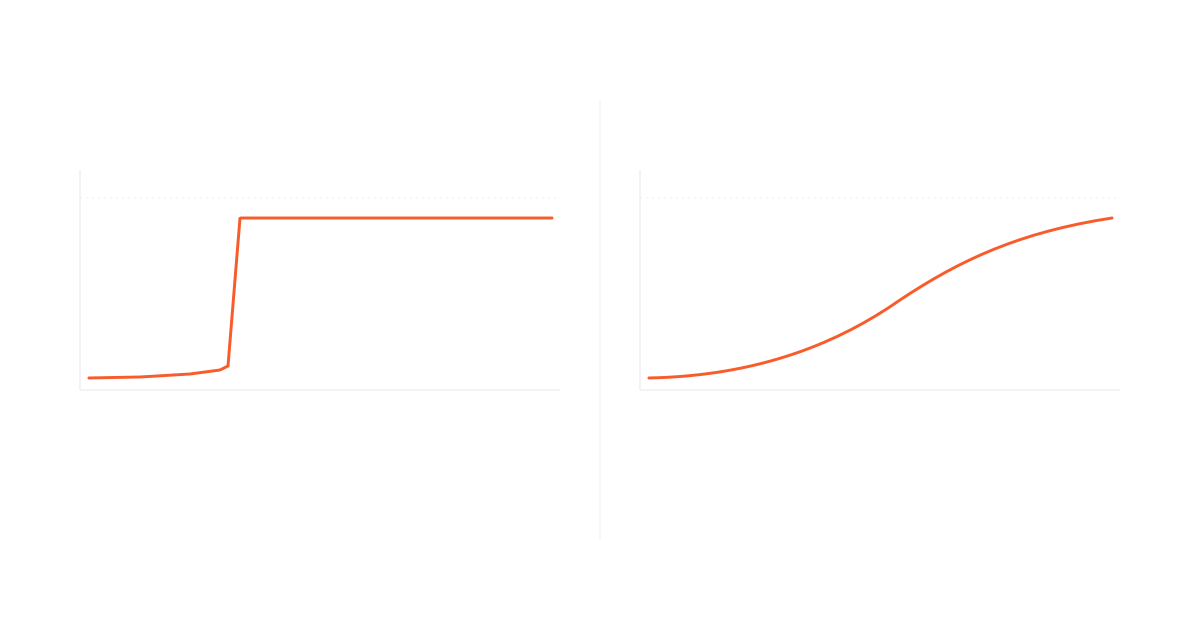
If executed as a single transaction, the order consumes available liquidity immediately, pushing the price upward and leading to a worse average entry. At that size, the market doesn’t just absorb the trade. It reacts to it.
Trades of this size are rarely executed in a single transaction for this reason.
With TWAP, the same trade is split into smaller orders and executed over time. Each fill interacts with the market more gradually, reducing price impact and improving the overall execution.
The asset is the same. The intention is the same. The outcome can be meaningfully different.
At this scale, execution is not a detail. It is a determining factor.
TWAP vs Market Orders
A standard market order prioritizes speed and executes immediately at the best available prices, regardless of impact.
TWAP takes a different approach. It trades more gradually, prioritizing execution quality over immediacy.
For larger trades, this difference becomes increasingly important.
When to Use TWAP
TWAP is particularly useful when trade size is large relative to available liquidity, or when execution quality matters more than immediate speed.
In practice, it is often used in two common scenarios.
The first is token accumulation. When building a position over time, executing gradually helps avoid pushing the price higher and improves the overall average entry.
The second is exiting a position. For larger holdings, selling all at once can move the market against you. Spreading execution allows for a more controlled exit.
Beyond these cases, TWAP is generally relevant whenever minimizing slippage and managing market impact are priorities.
Conclusion
As onchain markets evolve, execution is becoming an increasingly important part of trading.
Understanding how trades interact with liquidity, and choosing the right strategy, can improve outcomes in a meaningful way.
In many cases, the difference between execution strategies is not marginal. It is structural.
Get Started
TWAP is available on Velora. Try TWAP in the app and see how execution changes in practice.
FAQ
What is TWAP in crypto?
TWAP is an execution strategy that splits a large trade into smaller orders executed over time to reduce market impact.
When should you use TWAP?
When trade size is large relative to liquidity or when minimizing slippage is important.
Is TWAP better than a market order?
Market orders prioritize speed, while TWAP prioritizes execution quality and can improve average pricing for larger trades.
How does TWAP reduce slippage?
By spreading trades over time, TWAP reduces the pressure placed on liquidity at any single moment.
Does TWAP protect against MEV?
TWAP reduces exposure to large visible trades and includes additional protections on Velora.
Can you use TWAP to buy as well as sell?
Yes, TWAP on Velora supports both buy and sell execution.
Who typically uses TWAP?
Traders, DAOs, and funds executing larger positions.
What happens if you don’t use TWAP for large trades?
Execution quality tends to worsen as trade size increases, leading to higher slippage and less efficient pricing over time.
How can you start using TWAP on Velora?
Select your assets, choose TWAP, and define execution over time. Try it in the Velora app now.
Discover more about Velora

