
Introducing Velora Portal: the dashboard for the Velora swap API
Oct 5, 2026
Product


Getting a swap working is one thing. Giving users the right tools for the trade they want to make takes more. A trader moving a large position may need to spread execution over time. Someone else wants to set a target price and wait. A wallet user wants to swap across chains without managing each step along the way.
Velora (formerly ParaSwap) gives developers the execution tools to serve those needs. Now, Velora Portal brings the work of setting up and managing your API integration into one workspace.
Velora Portal is the dashboard for Velora Pro API users. You can manage API access, register apps, track trading activity and monitor estimated partner fees. Through the Velora API, your product can offer gasless swaps, TWAP, limit orders, OTC and cross-chain trading on Ethereum, Base, Robinhood and all currently supported chains.
Velora Pro API builds on the public Velora API with analytics, monetization tools and customer support. Compare Pro API plans.
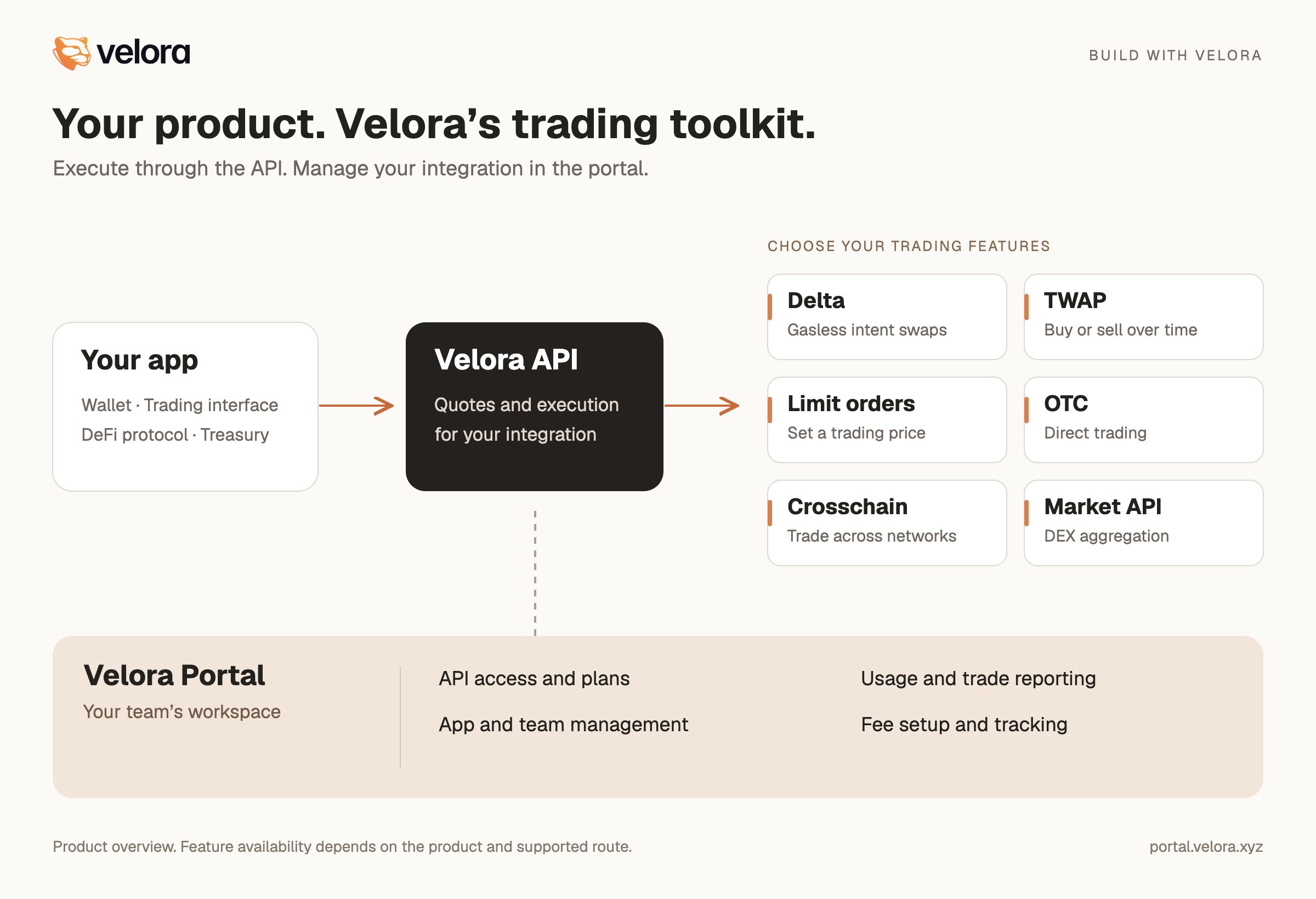
Use the API to build your trading experience and the portal to manage your integration. Feature availability depends on the product and supported route.
Add gasless swaps and TWAP orders to your product
Execution shapes how a trading app feels. The steps users have to complete, the control they have over an order and what happens between signing and settlement all matter.
Velora Delta is an intent protocol. Users specify the trade they want, and execution agents compete to fill it. Delta handles settlement, with gas abstraction and protection against maximal extractable value, or MEV, built into the execution flow.
For a wallet or trading interface, this means you can offer gasless swap execution within your own experience. Your team builds the interface while Delta handles the competition to execute the order.
TWAP, short for time-weighted average price, gives users another way to trade. It splits a larger buy or sell into smaller executions over time, which can reduce the market impact of trading the full amount at once.
A treasury rebalancing a position is a useful example. Instead of submitting one large swap, it can spread the order across a chosen period. Velora supports both buy and sell TWAP orders, with price protection and auction-based execution. The market can still move during the order, but users have more control over how they trade size.
These capabilities help you serve users whose needs go beyond an immediate swap, without building the execution infrastructure yourself.
Choose your execution flow: limit orders, OTC, cross-chain and the Market API
The Velora API also supports limit orders for trading at a specified price, OTC trading and cross-chain swaps across supported routes.
For applications that need to combine a swap with other contract actions, the Market API works as a DEX aggregator API: it aggregates DEX liquidity and builds transaction data for atomic onchain settlement. Your user signs and submits the transaction, giving your application control over how the swap fits into a larger operation.
That choice matters. A wallet, a trading terminal and a DeFi protocol may use the same liquidity infrastructure while needing different execution flows. Velora gives developers room to build for those differences.
Track API usage, swaps and partner fees
Once your integration is live, the portal helps you follow its activity.

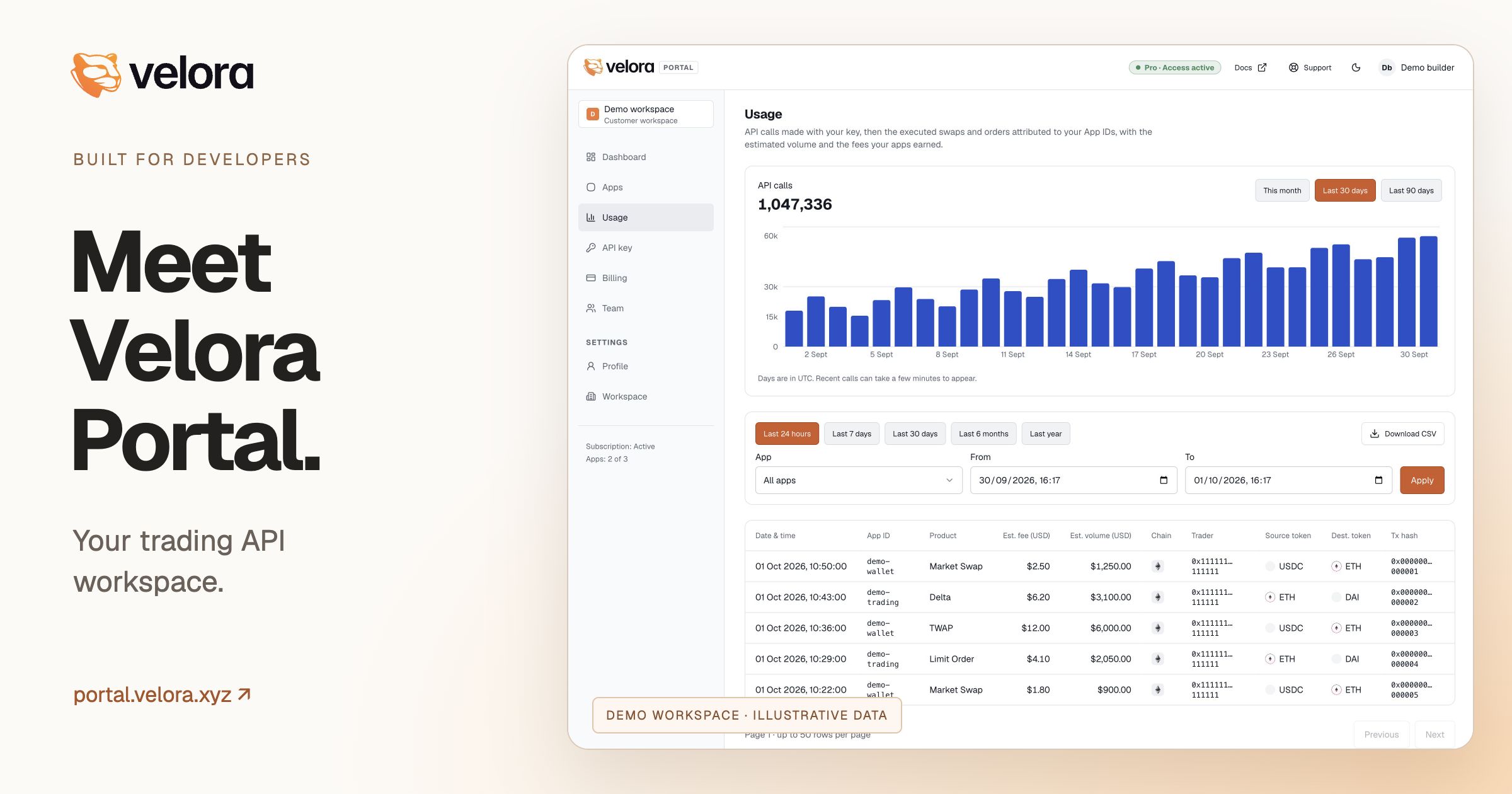
Track daily API calls alongside executed swaps and orders attributed to your apps. Inspect the product, chain and tokens involved in a trade, review estimated dollar volume and fees, or open the transaction onchain.
You can filter trading activity by app and date range, then export swap records as a CSV for your own reporting. If you run several integrations, individual App IDs let you examine each app's activity while sharing the workspace's API key and plan limits.
The portal also supports your monetization setup. Configure an app's partner fee and receiving address, apply the corresponding parameters in your API integration, and follow estimated fees alongside the trades that generate them.
Pay for your API plan by card or USDC
Velora Portal accepts both card and USDC payments for paid API plans, so your team can choose what fits its workflow.
Card payments go through Stripe's hosted checkout. For teams that prefer to pay in stablecoins, we've integrated Request Finance to make paying in USDC straightforward.

Pay by card or choose USDC through Request Finance, with invoice-based renewals you control.
Choose USDC during setup and complete your payment on Request Finance's hosted payment page. Your subscription activates once payment is confirmed, and you can find your invoices and payment status in Velora Portal.
USDC renewals are invoice-based: open the invoice and pay from your wallet registered with Request Finance. Nothing is charged automatically, so your team stays in control of each payment.
Whether you use a company card or hold your operating funds in USDC, you can pay for your API plan in the way that suits your business.
Get your team set up
New API users can create an account, choose a plan and register their first app through the portal. The dashboard brings together access status, API key status and request limits, with quickstart examples and links to documentation.

Review your workspace's access, apps and request limits, with integration examples close at hand. Illustrative demo data.
As your team grows, you can invite colleagues and manage their workspace roles.
We built Velora Portal to make the work around an integration easier, so your team can focus on the trading experience itself. Start with the features your users need today, then add more as your product develops.
Create your Velora Portal account, choose card or USDC payments for a paid plan, and use the Velora API documentation to start building.
Frequently asked questions
What is Velora Portal?
Velora Portal is the dashboard for Velora Pro API users. It lets teams manage API access, register apps, track trading activity attributed to those apps, monitor estimated partner fees and manage paid plans. It is available at portal.velora.xyz.
Is ParaSwap the same as Velora?
Yes. ParaSwap rebranded as Velora in 2025. Same team, same protocol: the Velora API is the API developers previously integrated as ParaSwap.
Can I pay for the Velora API with USDC?
Yes. Paid API plans can be paid by card through Stripe or in USDC through Request Finance. USDC renewals are invoice-based, so nothing is charged automatically.
Does the Velora API support gasless swaps and TWAP orders?
Yes. Velora Delta provides gasless swap execution with MEV protection, and Velora supports both buy and sell TWAP orders with price protection and auction-based execution.
What is the difference between Velora Delta and the Market API?
Delta is an intent protocol: users sign the trade they want, execution agents compete to fill it, and Delta handles settlement with gas abstraction. The Market API aggregates DEX liquidity and returns transaction data that the user signs and submits, which suits applications that combine a swap with other contract actions in one atomic transaction.
Can I track several apps under one account?
Yes. Each app gets its own App ID while sharing the workspace's API key and plan limits. You can filter trading activity by app and date range and export swap records as a CSV.
Discover more about Velora

